China Stocks regain 4,000-point ground with 2.65% surge
China Stocks regain 4,000-point ground with 2.65% surge
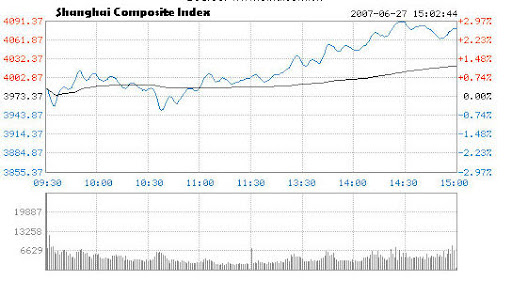
Chinese stocks formed a clear growth trend in the second half of the trading session today, after intensive but short-ranged fluctuations in the morning. The Shanghai Composite Index climbed 105.23 points to 4,078.60, up 2.65 percent from yesterday's closing.
Total turnover of the stocks enclosed by the two major indices was 197.5 billion yuan, higher than that of yesterday, but still one of the lowest figures in a month.
After opening higher from 3,985.72, the benchmark index had short-spread swings during the morning, hitting the lowest point at 3,948.29 at the mid-session. In the afternoon, it started to climb up in waves and reached the highest of 4,090.72 near the closing, but dropped a little afterwards
Of the A shares listed in Shanghai, 659 went up, 121 dropped and 59 finished unchanged. Hunan Huasheng was up 10.06 percent on top of the gainer's list. Hubei Wuchangyu and Chongqing Three Gorges Water Conservancy and Electric Power were also sealed with the maximum growth cap of 10 percent. Xishui Strong Year, on the other hand, dropped 5.65 percent as the biggest loser.
China Minsheng Banking Corp was the largest trader, both in terms of trading volume and transaction value, and saw its share price hike 5.22 percent to 11.70 yuan. The Industrial and Commercial Bank of China, following Minsheng in trading volume, added up 0.11 yuan. China COSCO continued marching north today, and rose 10.08 percent to 18.02 yuan, after a 93 percent jump in share price on its debut yesterday.
The Shenzhen Component Index, tracking the smaller Shenzhen Stock Exchange, opened higher from 13,309.34 and closed at 13,583.70, up 364.29 points or 2.76 percent. It went through the day within a range from 13,154.50 to 13,641.98.
Beijing Centergate Technology Holdings rose over 10 percent to lead the surge while Anhui Feiya Textile Development dropped nearly 10 percent on the bottom. TCL, with the largest trading volume in Shenzhen, and China Vanke, with the largest transaction value, were both down more than 4 percent.
Stocks in the agriculture, construction and food industries were the best performers. Yuan Longping High-Tech Agriculture pioneered the agricultural sector in with a 10 percent surge. Mining shares were also strong.
B shares finished mixed. Of the 109 listed B shares, 44 went up and seven ended flat. Anhui Gujing Distillery was against the biggest gainer. Closed-end mutual funds moved up today.
Hong Kong will step up efforts to enhance the scope and depth of cooperation in the capital markets with the mainland, said top financial officials of the special administrative region. They pledged in separate interviews with the China Securities News that the difference between H- and A-share prices will diminish eventually.
The Hong Kong Monetary Authority will push the region to establish a bilateral "supplementary, assistant and interactive" relationship with the mainland, said Joseph Yam, chief executive of the finance bureau. Hong Kong will encourages local financial institutions to set foot in the mainland market and welcome the domestic ones to "go out" through Hong Kong with easy access to the global market, Yam said.
Eddy C. Fong, chairman of the Securities and Futures Commission, said it is normal that there is price difference between the A- and H-shares of a same company, as there are still hurdles between the two markets, including systematic and exchange rate problems. But with closer ties between the two sides and the improvement of capital flow channels, the gaps will get smaller in the long run, he said.
Hong Kong had suggested to set up a cross-trading platform for the stocks listed on both of the markets, said Ronald Joseph Arculli, independent non-executive chairman of Hong Kong Exchange and Clearing Ltd. Such a platform, said Arculli, may help reduce the price discrepancies, but needs more commercial and political supports for its initiation. With better conditions in liquidity and price-recognition mechanisms in further cooperation between the two sides, the gap in share prices of the A+H companies will diminish, he said.
Mainland companies accounted for 73 percent of equity raised last year in Hong Kong and contributed to nearly half of the city bourse's market capitalization, according to regulatory data. Hong Kong last year hosted nearly 50 percent of the fund-raising activities by mainland enterprises, including giant banks and energy firms, which raised more than US$45 billion through stock sales abroad.
Although Chinese mainland authorities are now encouraging big state-owned enterprises to list domestically first, the frenzy for firms seeking a Hong Kong listing shows no sign of abating, industry sources said.
And the recent expansion of the qualified domestic institutional investor scheme will make Hong Kong the key beneficiary as mainland citizens channel funds outside to seek steady returns, said market watchers
China is also intensifying the monitoring of short-term capital inflows in a bid to curb speculative money rushing in from abroad, according to a statement of the State Administration of Foreign Exchange.
It will also detect and penalize fraudulent export activities, which often disguise speculative capital inflows, according to the statement. Speculative money often flows into China for investment in Chinese equity markets and in real estate projects, threatening the nation's macro economic control, the statement said.
Forex inspectors are required to investigate products and service trades, external debts and real estate and tourism sectors. Meanwhile, inspections of banking services have been stepped up, as commercial banks are major institutions dealing with forex settlements in China.
Analysts expect a lower growth rate in the consumer price index (CPI) in June, as futures prices of foodstuff hit historical lows this month. With affluent spot supplies, futures contracts of corn and wheat were traded at the lowest prices for this year.
As food price weights 33 percent in the equation of deriving CPI, the lower spot and futures food prices may result in a lower than expected CPI data, releasing pressure for inflation. The central bank may as well change its mind for another interest rate hike in the coming month, said analysts.


No comments:
Post a Comment